Thursday, 22 December 2022

Digitisation or Digitilisation - how does it matter?


Recently I watched a TV show where there were heated discussions amongst the panel members on the topic of digitisation and digitilisation. The first few minutes were spent by the experts explaining what they thought should be the right choice of word. For me, this debate made no sense at all.

“What's in a name? That which we call a rose by any other name would smell as sweet” as Shakespeare says.

I’ve been asked multiple times recently what “digital transformation” means? Given that by 2023 conservative estimates of annual expenditure on digital transformations are north of $2 trillion but with well over 50% of spend considered wasted to date, it seems like a fundamentally important concept to understand. 

"If I were given one hour to save the planet, I would spend 59 minutes defining the problem and one minute resolving it"  said Albert Einstein

One of my favourite questions I ask customers is, “What problem are you trying to solve?” "What is keeping you awake at night" Often, we race into solutioning a poorly defined problem. It’s not uncommon to launch into a transformation effort without fully understanding, or agreeing on, what success looks like. What might start off as an attempt to increase an organisation’s ability to more agilely respond to customer needs can easily become a misguided attempt to prescriptively implement transformation.So down to brass tacks: digital transformation is primarily about continually evolving an organisation’s culture and engagement "with customers" enabled by technology as appropriate. Digital transformations primarily are not about technology alone. It is about creating organisational agility in the face of changing customer needs and competitive landscapes. It is also about creating options that allow you to more frictionlessly pivot based on learnings, mitigating the need to be an organisational clairvoyant. Digital transformations typically have has four connotations:

1) Engage even tighter with your customer, and hyper-personalise your services
2) Optimise your operations 
3) Innovate your products/services
4) Empower your people

Understanding  the current and future state of customer journey and hyper personlisaing their experiences is key. The customer journey is usually about building a deep undersatnding of how your customers and business interact step by step, enumerating all the touchpoints. “Customers” broadly means employees, suppliers, or actual paying customers depending on your business. It about identifying opportunities to remove friction,  It about analysing the journey not purely to optimise but also determine new avenues that customers desire, and identifying moments where the customer can be delighted,. Its about identifying how to recover from subpar customer experiences. In the case of a successful hypermarket, these new avenues may include home delivery, mobile ordering, curb-side pick-up, table service and building feedback loops from each experience. The journey should be at a manageable level of detail without calling out every paralysing exception, but also without trying to over standardise or over generalise the experiences. Different types of customers typically act in different ways, creating multiple journeys. This can be addressed by creating personas for different customer groups. These form good approximations for behaviour, Over time we can iterate these personas, getting into more detail in order to drive a greater degree of personalisation - this is a key tenet of many companies’ transformation.

Data is the biggst enabler to deliver hyper-personalisation of services. Mixing data at rest with that in motion, and constantly enriching data from multiple sources, addressing data ownership, lineage issues and building scalable services that can be acccessed through standardised protocols will be an enabler of omni-channel experience.

Optimising Operations is about thinking granular on all aspects (such as Agile delivery, microservices patterns, infrastructure containerisation, cloud adoption). This is also about getting into a risk-mitigation mindset and buiding a fail-fast culture. It's also about adopting automation as much as possible, and building resiliency through DevSecOps and SRE cultures.

Adopting an agile way of delivering services and building an omni-channel customer experience will not happen having an archaic "do it all on my own" mentality. Building innovation with agility is about being sharing and using communities help, leveraging the partner ecosystems and rapidly tapping capabilities and resources to influence the entire value and supply chains. Agility is key here over getting it all right, and perfection is achieved over tests and runs.

And last, but not the least, people are an Organisation's biggest assests. One thing that the pandemic and the great resignation wave has taughts us is that the minds of the employees are liberated even more, and employers need to exercise additional care in managing this crucial asset. One of the ways is go back to Maslow's theory of esteem/self-actualisation and Pink's autonomy, mastery, and purpose to trigger intrinsic motivation. Empower people, entrust them with the new ways of doing things, build a blamesless, fail-safe culture. Frameworks such as SAFe teach us how this can be achieved within acceptable guardrails.

And how do we measure success? of course there are internal measures, lead cycle-time reductions, number of new features promoted, meantime to recover, change fail rates - but the single most effecive metric is CSAT. Does your customer feel the difference in a positive way? Perception is reality. Even if the perception may be far call away from what the glorious metrices read on your new shiny dashboards
- so it is a great point to note that transformations are always about working backwards from the customer and its about doing it alongside and with the business, - and remember never is a Technology transformation alone a Digital transformation.



Sunday, 20 November 2022

Thirukural - the beautiful expression of real-life in 7 words

Last week someone I knew, told me he met a young Doctor in Bengaluru practicing as GP in a clinic he attended for some ailment. He was intrigued that he shared a common last name as me. He told me that he was very mature in talking, understanding the problems, and diagnosis, and he said being a Gez Z his behavior was way beyond his young age!... Curiosity invoked I asked him which clinic he was talking about and he said Kaggadaspura clinikk health hub.

I was pleasantly surprised, I asked him what was the Dr's name - he told me it was Dr.Visagan Gugan!

I told him that he shared the same last name because he was my SON!

What a coincidence...

This brought to my fore one of my favorite Thirukurral verses.

Kural 69

ஈன்ற பொழுதின் பெரிதுவக்கும் தன்மகனைச்
சான்றோன் எனக்கேட்ட தாய்

Transliteration

When a mother hears him named 'fulfill'd of wisdom's lore,' Far greater joy she feels, than when her son she bore

 Plain Explanation  

The mother who hears her son called "a wise man" will rejoice more than she did at his birth

For those who do not know Thirukural, a small introduction to this great scripture -

 The Tirukkuṟaḷ or shortly the Kural (Tamil: குறள்), is a classic Tamil language text consisting of 1,330 short couplets, or kurals, of seven words each. In short, each Kural is a beautiful poetry of life skill coaching material,  the scripture is estimated to be more than 2000 years old, and written by a Saint named Thiruvalluvar.


=============

There are far too many good couplets to quote, but keeping the "Wealth of Children" chapter in focus, the following is a  further reference to this great scripture:

https://www.thirukkural.net/en/kural/adhigaram-007.html


Saturday, 12 November 2022

Why Bulkhead architecture

The bulkhead architecture is used to build fault tolerance, its a common application design that is tolerant of failure. In this architecture, elements of an application are isolated into pools so that if one fails, the others will continue to function. Use this pattern to:

  • Isolate resources used to consume a set of backend services, if your application can provide some level of functionality even when one of the services is not responding.
  • Isolate critical consumers from standard consumers.
  • Protect the application from cascading failures.
Typically in cloud-based applications, each service may have one or more consumers. Excessive load or failure in service will impact all consumers of the service. If we limit the max number of threads that can be used for an endpoint, we will always have some resources to process and this will avoid saturation of all endpoints. To implement the bulkhead pattern, we need to make sure that all our services work independently of each other and failure in one will not create a failure in another service. Techniques such as maintaining a single-responsibility pattern, an asynchronous-communication pattern, or fail-fast and failure-handling patterns help us to achieve.


Friday, 30 September 2022

Top Technology Trends that CTOs can blindly follow


1) ComposableArchiteture

Composable Applications allow polyglot microservices-based packaged-business capabilities (PBCs) or software-defined business objects. PBCs — for example representing a patient or digital twin — create reusable modules that the IT-Business fusion teams can self-assemble to rapidly create applications, reducing time to market. Champion composable architectural principles in all new technology initiatives, including application modernization, new engineering, and the selection of new vendor services. Buy standard PBCs on application marketplaces and integrate using APIs. According to Gartner, by 2024, the design mantra for new SaaS and custom applications will be “composable API-first or API-only,” rendering traditional SaaS and custom applications as “legacy.”

2) Data Fabric/ Data Platform

The value of data has never been more valuable. But often, data remains siloed within applications, so it’s not being used as effectively as possible. Data fabric integrates data across platforms and users, making data available everywhere it’s needed.

Within inbuilt analytics reading metadata, the data fabric is able to learn what data is being used. Its real value exists in its ability to make recommendations for more, different, and better data, reducing data management by up to 70%.

Identify priority areas to introduce data fabric solutions by using metadata analytics to determine current data utilization patterns for ongoing business operations. Prioritize areas with significant drift between actual and modeled data.

3) Cybersecurity Mesh

Using a cybersecurity mesh approach, you can integrate multiple data feeds from distinct security products to better identify and respond more quickly to incidents. Digital business assets are distributed across cloud and data centers. Traditional, fragmented security approaches focused on enterprise perimeters leave organizations open to breaches.

A cybersecurity mesh architecture provides a composable approach to security based on identity to create a scalable and interoperable service. The standard integrated structure secures all assets, regardless of location, to enable a security approach that extends across the foundation of IT services.

4) Privacy-Enhancing Computation

The real value of data exists not in simply having it, but in how it’s used for AI models, analytics, and insight. Privacy-enhancing computation (PEC) approaches allow data to be shared across ecosystems, creating value but preserving privacy. Approaches vary, but including encrypting, splitting, or preprocessing sensitive data to allow it to be handled without compromising confidentiality is the art of PEC. PEC platform uses homomorphic encryption so users can conduct data searches against its extremely sensitive data, with both the search and the results being encrypted

Investigate key use cases within the organization and the wider ecosystem where a need exists to use personal data in untrusted environments or for analytics and business intelligence purposes, both internally and externally. Prioritize investments in applicable PEC techniques to gain an early competitive advantage.

5) Cloud-Native Platforms

According to Gartner, By 2025, cloud-native platforms will serve as the foundation for more than 95% of new digital initiatives — up from less than 40% in 2021.

Lift-and-shift cloud migrations focus on taking legacy workloads and placing them in the cloud. Because these workloads weren't designed for the cloud, they require a lot of maintenance and don't take advantage of any of the benefits. 

Cloud-native platforms use the core elasticity and scalability of cloud computing to deliver faster time to value. They reduce dependencies on infrastructure, freeing up time to focus on application functionality instead.

Typical use cases are to build a cloud-native platform to create a portfolio of new digital services. For example, a bank can reduce the time to open an account to 5 minutes and add instant digital payments when using a well-architected technology platform. Deployment microservices architecture enables the integration of services such as savings, virtual debit card, and credit card services, allowing the system to easily scale to over 3.5 million transactions in two months.

6) AI/ML/Metaverse/ AR/ VR/Computer Vision

Distributed enterprise is a virtual-first, remote-first architectural approach to digitize consumer touchpoints and build out experiences to support products. While AI engineering is the discipline of operationalizing AI models, using integrated data and model and development pipelines to deliver consistent business value from AI, the use of NFT/blockchain-based metaverse builds on Web 3.0 principles to enable 'play to earn' gaming, AR/VR enabled retail e-commerce, real estate, hospitality, corporate training, induction on manufacturing shopfloors to aircraft engine simulations has seen a major boost in government and private investment.


Sunday, 11 September 2022

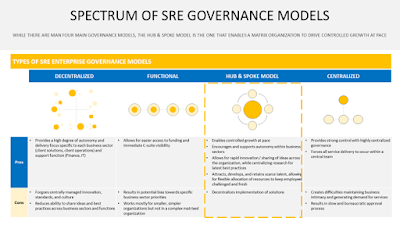
Spectrum of SRE Implementation Models


A Spectrum of SRE Implementation models

A significant aspect of SRE implementation at Enterprise is around the model that will enable governance and growth at pace. In this article we will look at the Hub and Spoke model as an approach to solve the SRE scalability challenges towards applying a product management life approach that enables rapid, repeatable SRE practices that are cross-pollinated from the spokes that are usually across business domains.


The Hub & Spoke model not only decentralizes the implementation of solutions, but it also allows for rapid innovation / sharing of ideas across the organization, while centralizing research for latest best practices. It helps attract, develop, and retains scarce SRE talent, allowing for flexible allocation of resources to keep employees challenged with new perspectives.


A few considerations are as below, as SRE capabilities mature, the governance model will evolve with more talent sitting in the spokes, meaning more work completed by the business sectors & the hub acting as a champion available when needed.


The SRE HUB exists to enable self-service model for the spokes. Typically built using the in-source model that builds embedded governance that is fit for purpose, the cross-pollination from spokes is key to following the product-based approach by the HUB.


Monday, 5 September 2022

The Evolution of the Mainframe


Mainframe and its evolution with Cloud Computing


The key attributes associated with mainframe computing are high resilience, high manageability, and scalability. Despite the momentum driving public cloud adoption, there remain workloads that cannot easily be migrated to the public cloud. Whether it is deemed too risky to migrate or reworking legacy code is cost-prohibitive, mainframe computing remains an integral part of IT ecosystem. There is a growing demand for reworking some mainframe workloads to run cloud natively on cloud infrastructure. But the risks associated with this often mean the core back-end mainframe system remains untouched in many organizations. APIs are used to provide external connectivity in order to enable enterprise developers to build modern functionality, combining the best the public cloud can offer with reliable transaction processing embodied in the mainframe.

Over the last few years, Cloud computing has evolved to the point where it is now promising the same level of scalability, flexibility, and operational efficiency that mainframe systems have long provided. In fact, in terms of scalability, it exceeds mainframe scalability. With scalability, throughput, operational efficiency, and arguably even resilience and failover, the cloud has arguably caught up with the mainframe of the 1990s or early 2000s. It is fair to say that cloud providers have made great strides in security and privacy, but, the mainframe is still recognized as the gold standard, with security baked into every layer in the systems stack.

The mainframe ecosystem and the z/OS operating system have evolved too and IBM has introduced specialty processors to run Linux workloads and support encryption, greatly increasing the flexibility of mainframe systems. Cloud providers offer support for specialist workloads for non-x86 hardware, such as graphics processing units (GPUs) for machine learning and AI. But the introduction of the latest addition to the z-series mainframe family, the z16, offers what IBM claims is the gold standard for highly secured transaction processing.

The mainframe environment is getting bigger with announcements such as those made at the recent launch of the IBM z16. These include quantum-safe cryptography to protect against the development of Quantum computers able to decrypt current encryption standards, on-chip AI acceleration to boost ML and AI execution and flexible capacity combined with on-demand workload transfer across multiple locations to further reduce the chance of service disruption.

On workload optimization, the two environments are developing in different ways. For example, the mainframe strives to deliver a consistent environment that can handle a wide range of workloads but is managed through the same set of frameworks and tools. The cloud, on the other hand, allows you to spin up dedicated specialized environments, e.g. for AI or analytics. Also, IBM Cloud’s ambition to make "mainframe as a service" available from its IBM Cloud and available across data centers, brings the mainframe capabilities closer to cloud-native offerings.

The modern mainframe, particularly LinuxOne version and the new Z16, it's pretty clear any claims of the mainframe being out of date or legacy stem from a fundamental lack of awareness. Indeed, the mainframe has continued to lead the way in many critical areas, delivering IT cost-effectively, and is far away from becoming obsolete.


LeaderNetworkpost Dr.Shivagami Gugan

https://www.linkedin.com/posts/theleadersnetworks_from-group-cto-to-aws-chief-technologist-activity-7457761754668777472-NHwK?utm_source=shar...